
World War II began on September 1, 1939 and lasted until September 2, 1945. During this time period, there was much tension between the United States and the Japanese, which led to the creation of anti-japanese propaganda. The United States Army poster, “Jap… You’re Next! We’ll Finish the Job” was created in 1944 by the Domestic Operations Branch of the Office of War Information. This poster demonstrates the power and masculinity of the American young man/breadwinner in World War II.
Through deconstruction of the image, is has been found that the poster possesses many elements that illustrate masculinity and the idea of the American breadwinner. The poster’s main attraction is Uncle Sam. He is shown having large muscles and is standing aggressively. He is obviously exhausted by the war and is rolling up his sleeve in order to give his final push in the end of the war. He is also gripping a wrench with a growl on his face and has his usual American flag suit on. Then, in red letters, the poster has the words “Jap… You’re Next!” written in massive font across the top of the poster. On the bottom in bold, black letters the words, ”We’ll Finish the Job!” is written.
In this poster, the main idea representing masculinity is clearly Uncle Sam. His large muscles and big hands exemplify the bold, strong, and courageous men that are fighting in the war. Also, the wrench he’s holding symbolizes the “handyman” or “jack-of-all-trades” type of young men that are taking part in the combat during World War II. This piece of propaganda was also meant to undermine the Japanese and establish a stronger and more “manly” United States. It could also be argued that “Jap” was most likely used to refer to the Japanese in a derogatory way. The second tagline “We’ll Finish the Job” depicts Uncle Sam as an economic soldier, not a military soldier. This is incredibly important because it shows how men during that time period were contributing to the entire nation’s economy and livelihood by the means of industry.
Through logos and pathos, the poster is able to persuade its audience. The creators of this poster, the Domestic Operations Branch of the Office of War Information, were a Federal agency during World War II. Their job was to dole out all of the official news in the United States and abroad. This proved to be credible and helps create a trustworthy source. Therefore, the audience trusts their views and ideas and may even follow them blindly, without any sort of thought whatsoever. In the text, the creators try to evoke emotions from the audience. When Japanese are referred to as “Japs”, the audience would react in various ways. They could either be in full agreement with the derogatory language, or be in complete discord with it. This helps highlight the author’s points, and makes their point of view obvious. Also, the authors use the phrase, “We’ll Finish the Job!”, which symbolizes the Americans “finishing,” or ending the Japanese. This phrase leads to an emotional response from the audience since “ending” someone or something usually means the dissolution or destruction of it.
In the reconstruction of this image, the message being established is the strength of the United States, instead of the masculinity of men during World War II. In order to achieve this goal, the text would have to be altered. Instead of a biased or misleading phrase against the Japanese, the lines should have empowering words that inspire Americans to help the war effort. The image of Uncle Sam does not need to be modified, since Uncle Sam is symbolic of the United States. Changing these aspects will change the message to the strength of the United States during World War II, because it changes the tone of the entire poster. The text before is degrading and derogatory towards the Japanese. If the attention is shifted away from the negative ideas of the Japanese and to the positive parts of the United States, it will reach a larger audience and be more enticing.
In the end, the poster “Jap… You’re Next! We’ll Finish the Job!” depicts the masculinity and power of the young men fighting in World War II. In the deconstruction of the image, it was concluded that Uncle Sam was the main representation of masculinity and the text referred to the Japanese in a derogatory manner. After reconstructing the poster, if the text was changed to a empowering phrase towards the United States, it would engage and draw the attention of more people. Through the analysis of this poster, the influence of signs, words, and symbols in our society has proven to be imperative in the creation of propaganda.
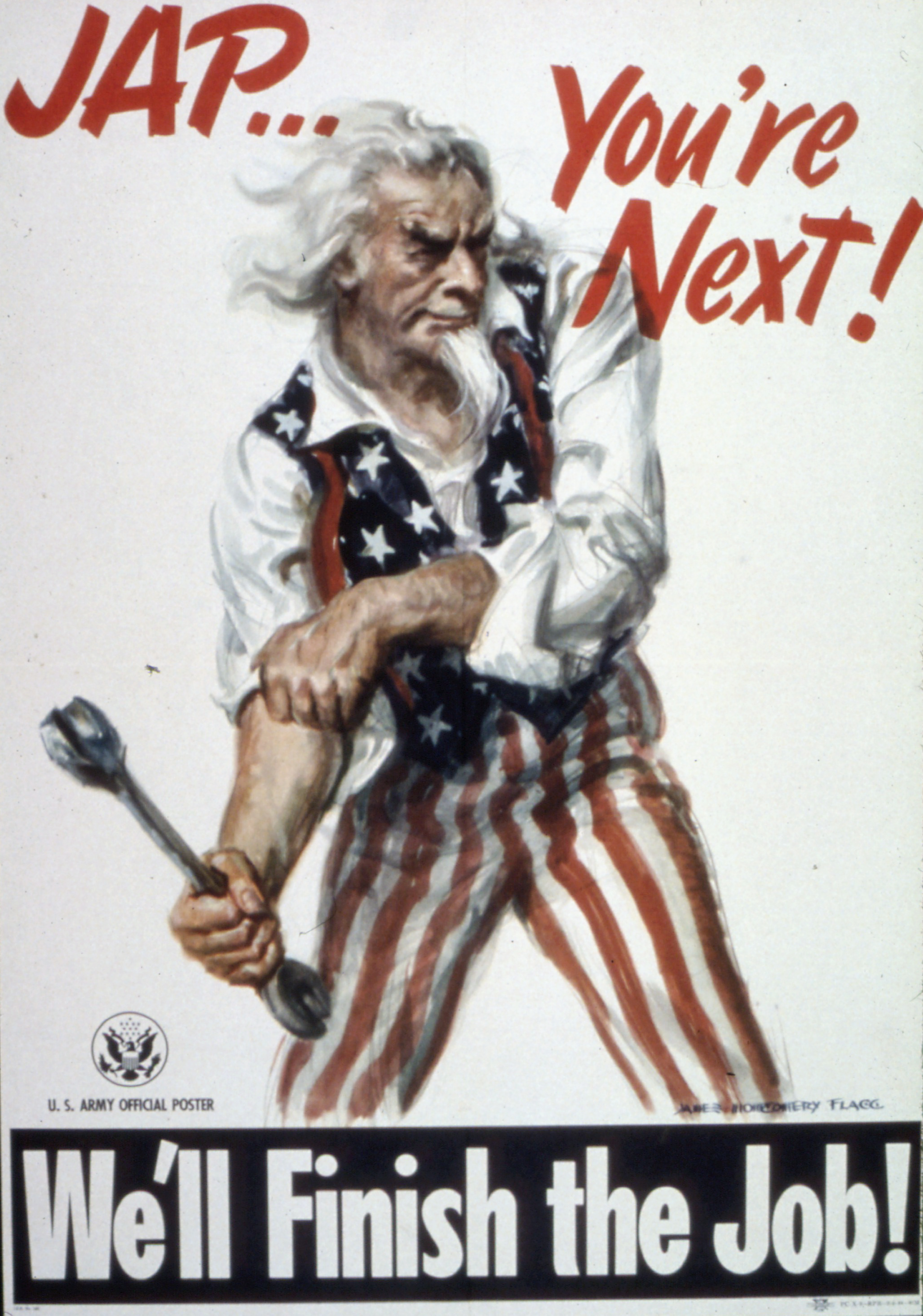
Flagg , James. “Jap… You’re Next! We’ll Finish the Job!”.
 English 101 Blog