The Paradox of Choice- Chapter 1: Let’s Go Shopping

In the book, The Paradox of Choice, the author, Barry Schwartz, discusses the abundance of choices we have to make everyday. He begins with the grocery store as an example. He explains the myriad of different kinds of products. Some of his examples included cookies, goldfish, sports drinks, juices, tea, chips, pretzels, eyeliner, dental floss, soups, vinegars, and cheerios. All of these products had hundreds of subsections that consumers had to choose from. Through his evidence and explanations, Schwartz makes concrete points and convinces me to agree with his perspective on whether the abundance of choices in today’s world is good or bad.

Schwartz writes, “Today, the modern institution of higher learning offers a wide array of different “goods” and allows, even encourages, student- the “customers”- to shop around until they what they like. Individual customers are free to “purchase” whatever bundles of knowledge they want, and the university provides whatever its customers demand”. In this example, he uses the copious amounts of choices when planning college classes. This example paints a perfect picture of what almost every college students has to go through and how difficult it can be.

He later writes,” Now, students are required to make choices about education that may affect them for the rest of their lives. And they are forced to make these choices at a point in their intellectual development when they may lack the resources to make them intelligently”. I absolutely agree with this statement. The average college student is about 18-19 years old. The educational system is expecting them to choose and plan their entire rest of their lives before they are even able to drink? That may be an issue.

So the question is, “Then why don’t we  just limit the freedom people have an only give them a few choices?”. Well Schwartz answers this with the idea of “voluntary simplicity”. “It’s core idea is that we have too many choices, too many decisions, too little time to do what is really important”. But, Schwartz doesn’t entirely agree with this concept. He says,” Taking care of our own “wants” and focusing on what we “want” to do does not strike me as a solution to the problem of too much choice”. His argument is solid because it’s mostly common sense. You don’t give people more opportunity to make their own decisions when trying to limit them. It just does not make sense.

In the end, Schwartz makes clear and compelling arguments when responding to the abundance of choices we have in the modern world. Through his evidence and examples, he has convinced me to agree with his perspective on the pros and cons of the affluence of choices today.
“Who Is The Patriot”

In the chapter, “Who Is The Patriot?”, the author, Howard Bryant explains the corruption in the sports leagues. He writes, “Sports teams had been charging the military to stage their events at ballparks, and the Pentagon had been paying the teams millions in taxpayer money-at least $6.8 million, to that point-to do it”. Bryant argued that all the homecoming ceremonies, first pitches thrown by returning soldiers, and all the support from the sports teams were either staged or paid for by the government. Bryant used many credible sources while making his points and many of them are provable. However, while he used many concrete sources and facts, some of the conclusions he drew had no correlation to his points.

Bryant tried to use the political examples of Donald Trump and the African American sports players kneeling in protest. He wrote, “In the theater of easy visuals, the black players knelt in protest were un-American, and Trump provoked this by using soldiers as the object of the players perceived disrespect”. These two examples have no correlation to his point earlier in the chapter. It seems as though he wanted to make his political views on the two subjects known without tying it back to his original reason for writing the piece.

Contrarily, Bryant made some authentic points. His paragraphs on the connection between the government paying the sports teams for acknowledgements is jaw-dropping. He writes. “The military was using sports to sell the business of war. And the teams? Well, they were in the business of making money…”. His vocabulary and the manner in which he provides evidence for his points, creates a trusting bond between reader and author. He later writes, “Protestors, African American athletes especially, constantly find themselves on the defensive”. Bryant uses this quote to appeal to his audience and evoke certain emotions from them. This also adds a better connection between author and audience because the audience feels as though the author really understands their thoughts and feelings.    

In conclusion, Bryant makes numerous concrete points in his chapter called, “Who Is The Patriot”. However, some of the evidence he uses to try to support his claims do not correlate to his overall point. Overall, this chapter opened the readers’ minds to the corruption in sports teams and allows them to create their own perspectives and feelings towards the issue.                                                                                                                                                                                                                                     

The Extraordinary Science of Addictive Junk Food

In an article, The Extraordinary Science of Addictive Junk Food, Michael Moss wrote an article to shed light on how junk food is made to be extremely addictive and how its advertised. He begins with explaining how the heads of major food companies, Nestle, Kraft, Nabisco, General Mills, Procter & Gamble, Coca-Cola, and Mars gathered together for a meeting. Their main topic of discussion was the enormous obesity epidemic and what they were going to do about it. James Behnke, the executive at Pillsbury, had a plan in order to help diminish America’s weight problem, but many of the other heads of the other companies were not too keen on changing anything. This article is one example of how greed can change an entire country.

The first speaker was the vice president of Kraft named Michael Mudd. He gave an extensive speech with a 114 slide presentation with facts and data regarding Americans and obesity. He said, “More than half of American adults were now considered overweight, with nearly one-quarter of the adult population – 40 million people- clinically defined as obese. Among children, the rates had more than doubled since 1980, and the number of kids considered obese had shot past 12 million.” He also highlighted the major effect on children in order to appeal to their emotions. This would convince them to follow Behnke’s plan.

He then connected all of the companies products to cigarettes and many of the other heads of the companies were immediately offended. Then, Stephen Sanger, head of General Mills, spoke up. He said, “Don’t talk to me about nutrition. Talk to me about taste, and if this stuff tastes better, don’t run around trying to sell stuff that doesn’t taste good.” His reaction and way of thinking is a perfect example of the greed America is suffering from. The heads of the companies don’t want to change the way their products are made since it leads to them being addictive. And if they are addictive, consumers will by more of them, leading to more sales for the companies. But, the sugary, salty, and fatty foods are horrible for the human body in the amounts Americans eat daily. The consumption of fatty foods directly correlate with increased blood pressure and increase the chance of developing diabetes. The ignorance and avarice of the CEOs and executives of America’s largest food companies are directly correlated with the influx in obesity in adults and especially children.

Visual Rhetorical Analysis

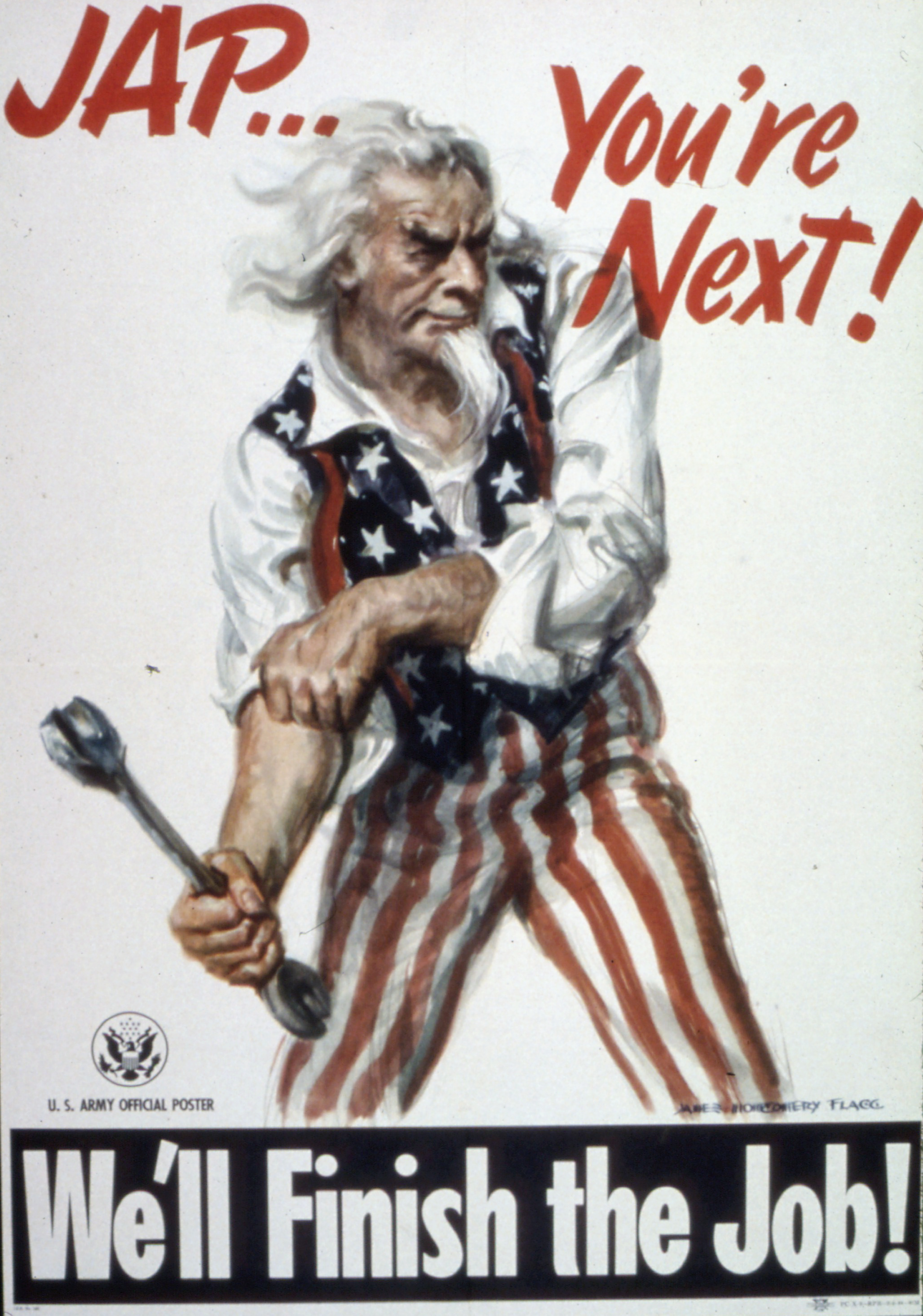
World War II began on September 1, 1939 and lasted until September 2, 1945. During this time period, there was much tension between the United States and the Japanese, which led to the creation of anti-japanese propaganda. The United States Army poster, “Jap… You’re Next! We’ll Finish the Job” was created in 1944 by the Domestic Operations Branch of the Office of War Information. This poster demonstrates the power and masculinity of the American young man/breadwinner in World War II.

Through deconstruction of the image, is has been found that the poster possesses many elements that illustrate masculinity and the idea of the American breadwinner. The poster’s main attraction is Uncle Sam. He is shown having large muscles and is standing aggressively. He is obviously exhausted by the war and is rolling up his sleeve in order to give his final push in the end of the war. He is also gripping a wrench with a growl on his face and has his usual American flag suit on. Then, in red letters, the poster has the words “Jap… You’re Next!” written in massive font across the top of the poster. On the bottom in bold, black letters the words, ”We’ll Finish the Job!” is written.

In this poster, the main idea representing masculinity is clearly Uncle Sam. His large muscles and big hands exemplify the bold, strong, and courageous men that are fighting in the war. Also, the wrench he’s holding symbolizes the “handyman” or “jack-of-all-trades” type of young men that are taking part in the combat during World War II. This piece of propaganda was also meant to undermine the Japanese and establish a stronger and more “manly” United States. It could also be argued that “Jap” was most likely used to refer to the Japanese in a derogatory way. The second tagline “We’ll Finish the Job” depicts Uncle Sam as an economic soldier, not a military soldier. This is incredibly important because it shows how men during that time period were contributing to the entire nation’s economy and livelihood by the means of industry.

Through logos and pathos, the poster is able to persuade its audience. The creators of this poster, the Domestic Operations Branch of the Office of War Information, were a Federal agency during World War II. Their job was to dole out all of the official news in the United States and abroad. This proved to be credible and helps create a trustworthy source. Therefore, the audience trusts their views and ideas and may even follow them blindly, without any sort of thought whatsoever. In the text, the creators try to evoke emotions from the audience. When Japanese are referred to as “Japs”, the audience would react in various ways. They could either be in full agreement with the derogatory language, or be in complete discord with it. This helps highlight the author’s points, and makes their point of view obvious. Also, the authors use the phrase, “We’ll Finish the Job!”, which symbolizes the Americans “finishing,” or ending the Japanese. This phrase leads to an emotional response from the audience since “ending” someone or something usually means the dissolution or destruction of it.

In the reconstruction of this image, the message being established is the strength of the United States, instead of the masculinity of men during World War II. In order to achieve this goal, the text would have to be altered. Instead of a biased or misleading phrase against the Japanese, the lines should have empowering words that inspire Americans to help the war effort. The image of Uncle Sam does not need to be modified, since Uncle Sam is symbolic of the United States. Changing these aspects will change the message to the strength of the United States during World War II, because it changes the tone of the entire poster. The text before is degrading and derogatory towards the Japanese. If the attention is shifted away from the negative ideas of the Japanese and to the positive parts of the United States, it will reach a larger audience and be more enticing.

In the end, the poster “Jap… You’re Next! We’ll Finish the Job!” depicts the masculinity and power of the young men fighting in World War II. In the deconstruction of the image, it was concluded that Uncle Sam was the main representation of masculinity and the text referred to the Japanese in a derogatory manner. After reconstructing the poster, if the text was changed to a empowering phrase towards the United States, it would engage and draw the attention of more people. Through the analysis of this poster, the influence of signs, words,  and symbols in our society has proven to be imperative in the creation of propaganda.


Flagg , James. “Jap… You’re Next! We’ll Finish the Job!”.

They Say, I Say: Part 3

CHAPTER 8: “As a Result”: Connecting the Parts

In this chapter, Gerald Graff and Cathy Birkenstein address the issue of how to connect all of different parts of your writing. The authors underline the importance of connecting each idea and sentence in order for the writing to flow smoothly and to be understood easily. After, they give some strategies in order to connect the ideas and sentences. They include using transition words and “pointing words”. Like transition words, “pointing words” allow an effortless flow of the words so the readers can understand your writing easily. However, the overuse of these words can be an issue. The authors also highlight the importance of repeating certain terms by using synonyms in order for the readers to fully grasp what the author is explaining.

WHAT I LEARNED: Before reading this chapter, I was unaware of “pointing words”. They will definitely help me in my writing in the future.

CHAPTER 9: “Ain’t So / Is Not:: Academic Writing Doesn’t Always Mean Setting Aside Your Own Voice

In this chapter, Gerald Graff and Cathy Birkenstein explain how college writing is not all about using big words and complex ideas. The authors describe how the writing should be fun to read and a mixture of informal and formal writing. This makes the writing not too complicated and makes the readers more interested. They also write that normal conversational language and academic language can intermingle perfectly to create a concrete claim. The authors end with saying that the certain style of writing is dependent on the writer’s audience and the purpose of the language in the piece they are writing.

WHAT I LEARNED: Before reading this chapter, I thought all college writing needed to have complex vocabulary and ideas. This will help me combine formal and informal writing styles more efficiently.

CHAPTER 10: “But Don’t Get Me Wrong”: The Art of Metacommentary

In this chapter, Gerald Graff and Cathy Birkenstein define metacommentary and explain its use in writing. Metacommentary is explaining your points and illustrating how your readers should interpret them. The authors explain it in comparison to a narration of your writing. You explain what is occurring. Using metacommentary helps your readers understand your writing better and helps your claims connect easier. The use of metacommentary allows your readers to answer any questions they might have and helps create stronger claims.

WHAT I LEARNED: Before reading this chapter, I did not know what metacommentary was. From now on, I will use it in my writing to help my readers understand my points.

CHAPTER 11: “He Talks About Deplores”: Using the Templates to Revise

In this chapter. Gerald Graff and Cathy Birkenstein explain the revision process of your writing.  They give some questions you should ask during your revision process if you have no idea what to do. They make sure the writers how they explain their information, the importance of their argument, the connections between their claims, and if all of their ideas are clear. After, they also note other questions to follow the other main questions. The author’s main purpose of writing this chapter it to help all writers revise their pieces. They even give an example of a revised essay to help their readers understand their points thoroughly.


WHAT I LEARNED: Before reading this chapter, I was not aware of these different ways to revise your own essay. Now I will be able to catch my mistakes better and help make my writing pieces more understandable.

Visual Rhetorical Analysis Practice

Image result for anti japanese us WWII propaganda background
  1. This image of propaganda was created by the U.S Army. The background is  critical because it was in response to the bombing of Pearl Harbor.
  2. The intended message is to intimidate the Japanese and bring comfort to the public, stating openly, that they will get “revenge”. I know this because of the vocabulary in the caption, and the facial features of the main subject, Uncle Sam.
  3. It applies to ethos because of the emotion it evokes from its readers. “Jap” is a derogatory term for Japanese people and “we’ll finish the job!” is referring to the “ending” of the Japanese people, which can evoke strong emotions out of its readers. They can be in agreement with its message or in complete discord with it.
  4. It’s intended audience is the citizens of the U.S. because this propaganda was plastered all around the U.S on buildings.
  5. This image was the U.S Army’s response to the bombing of Pearl Harbor. This also underlines the creation of Roosevelt’s Executive Order 9066 to imprison more than 110,000 Japanese Americans. The message is being delivered as a warning to the Japanese people.

Having It His Way


Since the dawn of time, males have dominated the social structure of society and the food chain. The male figures have also been the main supporters of the family, whether through hunting or being the breadwinners. In an article written by Carrie Packwood and Debra Merskin titled, “Having It His Way”, the authors underline the fact that his ongoing ideal has become damaging towards women and animals. The authors state that commercials on television specifically associate meat with a prevailing male mindset and the sexualization of women. The authors had concrete and accurate points with some supporting evidence but, some of them lacked clear evidence and left readers with questions.

Many fast food campaigns were targeted toward young men. Men were said to have the lead parts in commercials and did most of the talking, while women were primarily used as objects. Also, the authors wrote, “… A rudimentary perusal of most fast-food ads fails to suggest that the industry is constructing as association between meat and women specifically and frequently as it is between meat and men”. In short, the association between meat and women is non existent compare to the scale between meat and men.

The use of attractive women in commercials has occurred for many years.  For example, in Carl’s Junior commercials, they use attractive females as objects. For example, in one commerical they use a flirty, blonde, curvy, waitress to advertise their products. The company  has at least four other commercials on television that have beautiful women eating hamburgers seductively in order to gain the attention of straight males. But, the authors only picked certain commercials that supported their claims. The authors’ write, “in selecting texts, we sought fast-food television commercials that appeared to be targeted to males.  They never address any counter arguments or give any examples of other commercials that don’t involve women.

In the authors’ analysis of the commercials, they did apply sound evidence for their claims, but the background for their evidence was absent. Also, some of their evidence was contradictory. The authors’ write, “… men had the lead parts and did most of the talking, women were used primarily as objects of the male gaze” and later write, “the latter is the only ad in this series in which men appear”. These statements are completely contradictory. If that was the only ad that used a male, why state that usually men had the lead parts and women were just used as objects?

After analysis of the article, it has been concluded that the authors made valuable points, but there was a lack of concrete evidence for some of their claims. The lack of evidence leaves much room for debate and questions.

They Say, I Say: Part 2

Chapter 4: “Yes/ No / Okay, But”

In chapter four, Graff and Birkenstein concentrate on the three most common ways to respond to other’s ideas. They advise you to respond with a yes, no, or okay, but. They write that it’s a strong tactic to directly state whether you agree, disagree, or agree to disagree. It allows the receiver to fully understand your viewpoint. They also promote the act of disagreeing, since it calls for critical thinking and problem solving. After that, they provide some templates to aid in writing out your “disagreement”. Contrarily, they also promote agreeing, but with a difference. They say that even if you agree, you need to bring new ideas and perspectives into the conversation. And they also provide some templates to help create a supportive argument while also adding new ideas. Finally, they analyze the fact that it is okay to be unsure of where you stand on a topic. They explain that some people might think they seem evasive or might upset their audiences since they aren’t giving clear-cut answers. But, in the end, how the readers judge you isn’t important and they only important thing is the quality of what you write about.

What I learned: Before reading this chapter, I had no idea that there were specific types of ways to respond to people’s ideas. I thought they were just opinionated responses that did not follow any sort of format.  

Chapter 5: “And Yet”

In chapter 5, Graff and Birkenstein explain the importance of being able to differentiate between the views of the readers and your own. The authors highlight the use “voice markers” in order to do this. For example, “yet” is an example of a voice marker. After that, they give some templates to help format the ways to identify who is saying what in your writing. They also talk about avoiding first person writing since it can be boring to read boring to read “I” over and over again.  

What I learned: Before reading this chapter, I had not realized some negative effects of writing in first person. It will make me rethink the point of view I write in.

Chapter 6: “Skeptics May Object”

In chapter 6, Graff and Birkenstein describe the importance of criticisms and what they teach. They advise you to listen to these critiques and they will help you improve your writing. They also highlight anticipating objections and not allowing the objections to undermine your credibility and argument. You should always entertain the counter argument and have a rebuttal. If you do not, you could be seen as close minded and it could leave the readers with questions. Then, the authors provide templates for acknowledging the objections and identifying those who question or object your viewpoint, also known as “naysayers”. They then explain how to introduce objections fairly, answer the objections, and give some templates in order to accomplish them accurately.

What I learned: Before reading this chapter, I was more closed off to accepting critiques of my writing. But now, I am fully aware of the benefits and will try harder to listen to the critiques.

Chapter 7: “So What?”

In chapter 7, Graff and Birkenstein underline one of the major problems in writing, which is when the authors do not address why their arguments even matter. Answering these questions are crucial in your writing. It makes sure that the readers are not left with any questions and it ties up all the loose ends. You want to be as clear and straightforward as possible, while also explaining your arguments and reasons in grave detail. Then, the authors provide templates to state who “cares” and help writers explain why readers should care about what they are writing about. After that, writers need to answer the “so what” question. Why is this important? This further allows the authors to explain the importance of what they are writing about. Finally, the authors give more templates on establishing why your claims matter. And they explain what to do when the readers already know that the author’s topic matters.

What I learned: Before reading this chapter, I was not aware of the major problem of forgetting to explain why your argument matters. For me, I thought it was common sense to explain your viewpoint and why it is important in argumentative pieces.

Critical Analysis

Kendall Dick published an article about learning a foreign language. I thought this was really interesting and pertained to me, since I speak a foreign language.  

Brief Summary:

The author argues that everyone around the world should learn another language. She declares that bilingualism is now the most useful real world skill to ever exist. The study of a foreign language is mainly about connecting and communicating with others in different ways. It also helps you understand their culture and make connections to your own culture.

Rhetorical Situation:

  • Author’s background:
    • Kendall Dick is a sustainability activist, writer, and travels all around the world. She is also a missionary.
  • Target Audience:
    • Teenagers and young men and women. Her language/slang and tone reveal that she is targeting a younger audience since they are able to absorb a new language better.
  • Context:
    • Published on January 11, 2018, after traveling around Europe and experiencing the advantages of knowing a foreign language first hand.

Argumentative Elements:

  • Main argument:
    • Every single person around the world should learn a foreign language.
  • Claims:
    • Travel becomes cheaper and easier
    • Opens up job opportunities
    • Foreign language study enhances brain capacity
    • Form meaningful friendships and bonds with people in different cultures
    • Creates a more open mind
    • Aids in understanding one’s own language and culture better
  • Evidence
    • Studies on more grey matter (supports cognitive advancement) in brains in the region where language is developed
    • Studies on enhanced decision making when bilingual
    • Learning another language draws your focus to the mechanics of language (grammar, conjugations, sentence structure)
    • Study in Spain’s University of Pompeu Fabra – multilingual people are better a perceiving and understanding their surroundings (people, cultures)
    • Knowing the language in foreign countries saves money on interpreters and guides.
    • You can acknowledge and adopt other cultures easier because of the ability to communicate with them

Evidence Appeals:

  • Logos/Questionable logic:
    • Solid arguments and she acknowledges some rebuttals. The claim about it being “sexy” is impertinent to her argument.
  • Ethos (Credibility):
    • Her credibility is built through her reference to studies relating to the physical benefits of learning a foreign language and the personal examples she used when she traveled.
  • Pathos: The language the author uses is used in a way to persuade readers to learn a foreign language. It is welcoming and friendly, while also being aggressive when trying to convince the reader.

Definitions:

  • The terms she used in the article are not extravagant and are easily understandable. This shows her “call” to a larger audience and how universal her article is.

Arrangement/organization:

  • Consistency:
    • Consistent in her main idea. She restates her thesis and supports it consistently throughout the entire article. She provides a kind of “call to action” at the end, which I didn’t think was needed.
  • Arrangement:
    • Well structured. She introduced her topic and the rest of the article flowed nicely. She fully explained all her claims sequentially and it was logical.

Evidence

Have you ever heard about the Salem Witch Trials? Well if you haven’t, what rock have you been under? The Salem Witch Trials led to more than 150 men and women being imprisoned. The evidence used against these men and women were based on “evil spirits”, which seems absurd today. This is a perfect example of how we use evidence to support our beliefs whether the evidence is good or bad.

In the passage, Evidence, the author emphasizes our use of inductive reasoning. The author states that inductive reasoning is a strategy of guessing based on past experience. She then compares humans to computers saying that computers lack this said strategy. She explains that computers do not have logic, so they are not able to rule out millions of answers to a multiple choice problem, since all the answers could be theoretically possible or logically valid. However, human beings can easily answer the questions because we can relate it back to our experiences and care about what is probable. To sum it up, humans can make sounder and more decisive evaluations because of our use of past experiences in inductive reasoning.

Contrarily, the author discusses how inductive reasoning can be unreliable. The main idea or thing we accumulate through inductive reasoning is usually probabilistically true, meaning they could be false. For example, the author uses the case of stereotypes of Muslim people. She writes,” This Muslim is a terrorist; All Muslims are terrorists”. This is a perfect example that highlights the “jumping to conclusions” when inductive reasoning is being used. Basically, inductive reasoning can be flawed because of the limited information and experiences we have to use in order to create an idea.

The author also highlights another inductive bias known as confirmation bias. “Confirmation bias in the tendency to give more weight to evidence that confirms our beliefs than to evidence that challenges them”. The author uses the example of a woman named Elizabeth O’Donovan. One night, she got into an argument with a friend about whether Orion is a winter constellation. Elizabeth insisted that it was not over and over again while her and her friend stood in a parking lot in the middle of December, pointing at Orion. She thought is was some “crazy astronomical phenomenon” because she thought it was a summer constellation. This example proves exactly how confirmation bias was used, since she purposefully neglected evidence that supported a countering claim, since it did not coincide with her beliefs.  

Inductive reasoning is the main way humans make assumptions or guesses in certain situations. It’s what differentiates use from computers. But, there are some implications with inductive reasoning, so be careful. In the end, think before jumping to conclusions and make sure your reasoning is just and well-mannered.